A Slow Read of a Library Floor Plan
A slow read of a library floor plan helps you spot entrances, routes, quiet zones, and ambiguous labels before a visit or while finding your way inside.
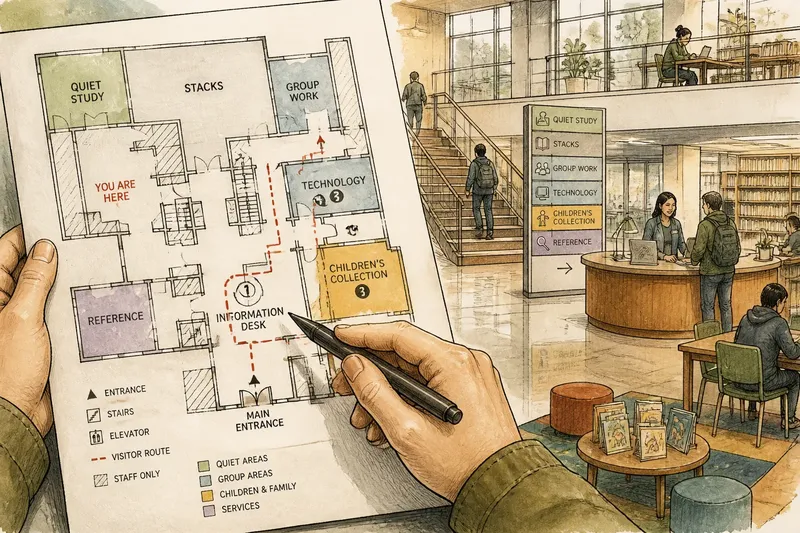
You pause at a library directory, one hand on your bag, trying to tell whether the stairs lead to the reading room or the children’s section. A slow read of a library floor plan can turn that crowded patchwork of lines and labels into clues about how the place is organized—and help you decide where to go next.
Start with the entrance when the plan feels like a maze
A plan often shows a building as if every room mattered equally. A visitor experiences it differently: through an entrance, then a sequence of choices. Find the entrance symbol first. If there are several, look for labels such as “main entrance,” “accessible entrance,” or “after-hours entrance.” Each one may connect to a different part of the building.
Next, trace a route from that doorway to a recognizable anchor: the information desk, elevator, central stairs, or a prominent open area. Thick lines, arrows, and numbered markers may indicate a suggested route, but don’t assume every line represents a public passage. Some plans include staff-only corridors or walls that resemble routes at a glance.
When the path still seems unclear, follow it in short sections rather than trying to memorize the whole building. Imagine you enter through the east doors looking for a computer. You spot the desk just inside, then trace the corridor from there to the room labeled “Technology.” The expected result is a usable sequence of landmarks, not a perfect mental copy of the plan.
Check why a route appears to stop
A line that ends abruptly can mean a dead end, a doorway omitted for clarity, or a connection on another floor. Look for nearby stair or elevator symbols and floor labels. If the destination is upstairs, compare the same landmark on the next floor before deciding that the route is blocked.
Plans also simplify details. A broad open area might contain shelves that are not drawn, while a narrow corridor may have furniture that changes how it feels to pass through. Treat the plan as a guide to relationships—what connects to what—not as a precise picture of every obstacle.
- Trace from a named entrance. If the route starts somewhere else, reset at the doorway you expect to use.
- Look for floor changes. Match stairs and elevators across the plans before following a route that seems to vanish.
- Find a landmark. A desk or open area can make a complicated corridor easier to read.
- Check for access labels. A route marked for staff may not be the visitor route.
Read zones as clues, not hard borders
Libraries often mark areas by activity: quiet study, group work, children’s books, local history, or public computers. The labels show how the institution intends people to use the space, but the edge between zones may be gradual. A table just outside a quiet-study label could still be part of that atmosphere, while a room marked “meeting” may have a separate entrance and different access arrangements.
Notice what sits between zones. A service desk near the entrance may help visitors before they reach the stacks. Children’s areas are often placed where families can find them without crossing every quiet room. Group tables near a central aisle may make conversation less disruptive to individual study. These are clues, not universal rules; buildings vary in layout and policy.
If the plan uses colors, check the legend before assigning meaning. One color may distinguish collection types, while another marks public services or accessible routes. Without the legend, a bright block can be mistaken for a separate room when it merely highlights a category.
When do labels and symbols leave questions?
What does “Stacks” mean on a library plan?
“Stacks” usually refers to shelving for the library’s collections, but the label alone may not say whether a section is open for browsing or arranged for staff use. Look for a nearby collection name or ask at the information desk if access is unclear.
How can I tell whether a room is open to visitors?
Public rooms are often labeled by function, while staff areas may be marked “staff,” “workroom,” or “restricted.” If the plan does not distinguish access, use the posted signs at the entrance or check with library staff rather than inferring permission from an open doorway.
Why do two library maps show different routes?
One may cover a single floor while another marks entrances, temporary closures, or accessible paths. Compare the map’s title, floor label, and date or update note, then follow the version displayed for the area you are in.
Use labels to resolve a mismatch on the ground
Sometimes the plan says “reference” while a wall sign says “research help,” or a room name differs from the wording on a directory. These labels may describe related services rather than identical rooms. Search for a second clue—a nearby desk, collection marker, or room number—before treating the mismatch as a wrong turn.
Room numbers can offer a useful cross-check. If the plan shows a numbered room beside the elevator, look for that number on the door or wall plaque. Numbers may follow a floor-based pattern, but don’t assume the sequence is obvious: older buildings can retain labels that do not match a simple walking order.
Choose a next move without memorizing the whole building
Once you have identified the entrance, a landmark, and the zone you need, stop reading the rest of the plan. Keep only the next decision in mind: turn at the desk, take the elevator, or follow the collection sign. At the next junction, use the directory or wall labels to confirm your direction.
A slow read of a library floor plan is most useful when it stays provisional. The drawing gives you a route to try; signs, room numbers, and the arrangement of doors help you adjust as you go. If a destination remains uncertain, asking staff for the nearest landmark can be more useful than studying every line again.