The History of the Button, From Ornament to Everyday Fastener
The history of the button links ornament, clothing design, and identity; learn how materials and placement turn a small fastener into a telling detail.
A coat button flashes beneath a streetlamp as someone reaches for a door. The history of the button is written in moments like this: a small object that can close cloth, catch the eye, and signal how a garment should be read.
Buttons did not move from decoration to fastening in one universal sequence. Their roles varied by place, period, and garment, and the surviving objects do not tell one simple story. Still, specific examples show how ornament and practical use came to share the same small surface.
Buttons served as ornaments in some early clothing traditions
Some early buttons recovered by archaeologists appear to have been sewn onto clothing as ornaments rather than used as closures. That cautious description matters: finds from different regions and periods cannot be treated as evidence for a single origin or a universal first use.
Buttons and button-like objects have been made from materials including shell, bone, stone, and metal. Their forms reflect both the material available and the skill of the maker. A pierced shell or a polished stone disc could be decorative without having a matching buttonhole; ties, pins, or wrapped edges could hold the garment together instead.
Once makers paired buttons with loops or buttonholes, ornament and function could meet. The button became a point where two edges joined, but its material, shape, and placement remained visible. Utility did not make decoration disappear.
Buttonholes made closures part of garment design
A button works with an opening made to receive it. Compared with tying a knot or piercing cloth with a pin, a button and buttonhole provide a repeatable way to close and reopen a garment. The arrangement also gives makers control over where fabric edges meet.
Rows of closures could run along a sleeve, bodice, or coat front. Their placement helped shape how a garment sat and moved, while the number and spacing of buttons gave a seam its own visual rhythm. A long row asks the eye to travel; one prominent button can make a single point of emphasis.
Buttons also make dressing a sequence of small gestures. A wearer fastens each one in turn, and the design determines whether that sequence feels discreet or conspicuous. The hardware is modest, but its location can affect the whole outline of a garment.
Materials and workmanship shaped a button’s appearance
Material changes the impression a button makes. Wood, horn, polished metal, glass, and cloth-covered forms have different textures and visual weight. A carved surface draws attention to workmanship; a fabric-covered button can recede into the garment.
Where buttons were costly or labor-intensive, they could serve as portable ornaments as well as closures. Detachable sets could be kept and reused, allowing a wearer to change a garment’s appearance without replacing the clothing itself. That practice depended on the garment and its context, not on a single rule about all buttons.
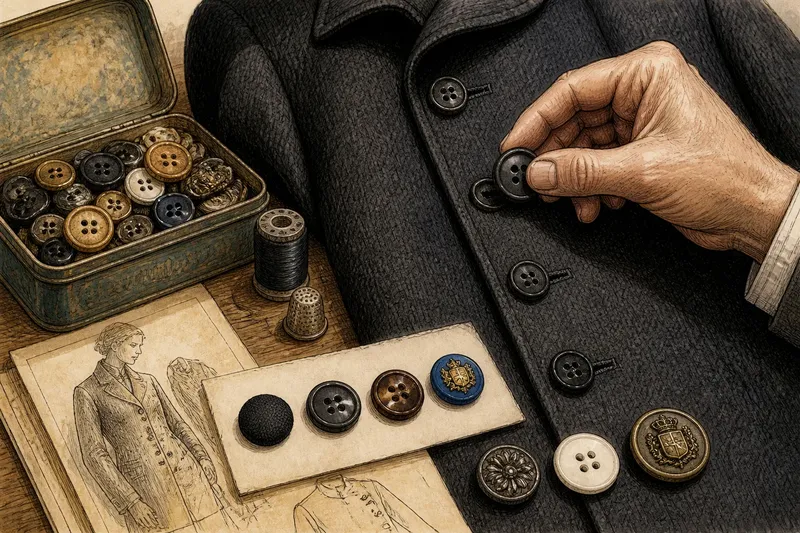
Even a modest material can be chosen for a clear effect. Imagine a tailor working with a charcoal wool coat and a box of hypothetical replacement buttons: matte black horn, covered wool, and bright enamel. The tailor compares each option against the coat. Covered wool nearly disappears, horn adds a subtle variation in texture, and enamel creates a distinct spot of color; the choice depends on whether the coat should look quiet or make its closures visible.
Uniform buttons make group identity visible
On a uniform, repeated buttons help make separate garments look like part of a set. Their finish, emblem, or placement can identify a school, service, workplace, or club, though the meaning belongs to that group’s conventions rather than to the button alone.
A crest or number turns a small surface into a compact sign of affiliation. Since the emblem is attached to the clothing, it is visible alongside the wearer’s other choices. Standardized buttons can make a group recognizable even when other details vary.
The same visual logic appears in less formal clothing. Matching buttons on team jackets can create a shared look without a large graphic. If one is missing or replaced with a conspicuously different one, the contrast may stand out because the rest of the garment follows a consistent pattern.
Designers use buttons to direct attention
A line of contrasting buttons can draw the eye down a coat front. Oversized closures may give a simple shape a playful or architectural quality, while clusters or unusual spacing make the fastening itself part of the design.
Some buttons are decorative rather than functional. A garment may use a zipper, snap, or concealed hook for closure while keeping buttons as visible references to tailoring or an earlier style. In that case, their role is visual, not mechanical.
Say a person has a plain dark cardigan with matching buttons and, in this invented situation, considers replacing them with bright, mismatched ones already in a sewing tin. After laying the buttons along the cardigan’s front, the person sees that the colors interrupt the dark surface and make the closure line more prominent. The expected result is a cardigan that draws more attention to its center, without changing how it fastens.
Button placement can preserve social conventions
In some clothing traditions, the sides used for buttons and buttonholes differ between garments associated with men and women. Explanations for this convention are often repeated as settled history, but the practice varied across places and periods. A safer observation is that makers and wearers can turn a repeated design choice into a familiar social code.
Such conventions can make a garment recognizable as belonging to a category, whether or not the wearer gives the detail conscious attention. A designer may keep the expected arrangement, reverse it, or disregard it. Each choice can make a garment feel familiar or deliberately unusual.
Fastening itself can also carry social meaning. A fully buttoned collar may look formal in one setting, while an open jacket may seem relaxed. The hardware remains practical, but the way it is worn becomes part of a shared visual vocabulary.
Repair keeps buttons in use
A loose button can be a straightforward repair, and a spare sewn inside a coat may make replacement easier. A small tin of saved buttons offers another source, though a visually close match is not always a functional one.
Compare a replacement with the remaining buttons: look at diameter, thickness, number and placement of holes, and how it attaches to the fabric. Then check whether it passes through the buttonhole without strain. If it does not, choose a thinner or smaller option; if the match is awkward but the garment is sturdy, a clearly contrasting button may work as a visible repair.
For delicate, valuable, or historically significant clothing, ask a tailor or textile conservator before altering it. A repair can preserve the original look, or it can become a new design detail; the right choice depends on the garment and the owner’s intention.
What do button details tell us?
Why are some buttons decorative rather than functional?
Designers may use buttons to create a visual theme even when a zipper, snap, or concealed hook does the practical work. The familiar form can suggest tailoring or a particular style without opening the garment.
What makes a button look carefully made?
Even surfaces, clean edges, precise holes, and visible carving can suggest attention to workmanship. Context matters too: a simple button may look more considered than an elaborate one that clashes with the garment.
Why do uniform buttons carry symbols?
An emblem can make affiliation visible in a compact, repeatable form. Its meaning depends on the organization and its conventions, while the standardized button helps the clothing read as a uniform.
How should I choose a replacement button?
Compare its thickness, hole arrangement, attachment, and appearance with the remaining buttons, then check that it passes through the buttonhole comfortably. If it does not, choose a better-fitting option or ask a tailor for help with a delicate garment.
The history of the button is still present in the choice between a closure that disappears and one that asks to be noticed. Before replacing or judging one, look at the hole, the thread, and the surrounding cloth: those details reveal whether the button is meant to work quietly, decorate boldly, or do both.