Why a Handle Changes the Character of a Cup
Why a handle changes the character of a cup comes down to placement, shape, and visual balance—learn how to compare forms and choose one that fits.
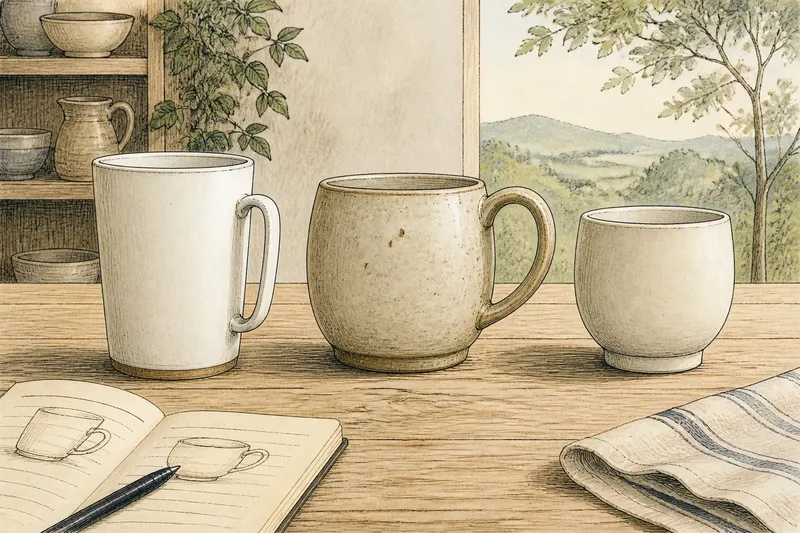
Set two cups beside a saucer and the one with its handle pointing outward can seem ready to pick up; turn that handle inward and the same cup looks tucked away. That small shift is part of why a handle changes the character of a cup: its position, outline, and connection to the body guide the eye and suggest how to approach the vessel.
A handle is not simply a grip added after the cup’s design is settled. It changes the silhouette, adds a visual counterweight, and establishes a preferred side. Comparing three broad approaches—an aligned handle, a projecting loop, and a compact or absent handle—makes those effects easier to see. None is inherently better; each suits a different mood, setting, and way of holding a cup.
An aligned handle keeps the cup’s outline composed
An aligned handle follows the body’s visual direction instead of breaking sharply away from it. On a straight-sided cup, a narrow handle may continue the upward lines of the rim and foot. On a rounded cup, a gently curved attachment can echo the body’s arc. The handle remains visible, but the eye reads it as part of one continuous design.
This approach often suits cups meant to feel restrained, orderly, or easy to place among other tableware. Imagine a small breakfast table with a straight-sided porcelain cup beside a simple plate. Its slim, close-set handle keeps the profile tidy, so the pair looks composed without demanding attention. The expected visual effect is a strong vertical form with a quiet side accent.
Look closely at where the handle joins the cup. Attachments near the rim and lower body can make it feel anchored across the cup’s height. A handle joined within a narrower band may appear more delicate, even if its outer shape is similar. The negative space inside it matters, too: a narrow opening reinforces a compact silhouette, while a broader opening gives the cup visual breathing room.
An aligned handle fits when you want the vessel to read as a single, calm shape or when several cups will sit close together on a shelf. It can be less expressive if its outline is so similar to the body that the cup’s side becomes hard to distinguish at a glance. For a more pronounced gesture, a loop that reaches farther from the body changes both the outline and the sense of balance.
A projecting loop makes the cup feel more open
A loop that stands away from the body creates a clear pocket of space. That gap matters as much as the material forming the handle: it separates the cup from its surroundings and gives the silhouette a more animated edge. A broad oval loop can make a rounded body look softer, while a narrow angular loop can introduce a crisp counterpoint.
Projection also affects how the cup appears to balance. The body remains the visual mass, but the handle draws the eye outward. If it is especially large, the cup may seem asymmetrical or playful; if it is modest, it can simply make the vessel look approachable. A loop that points strongly to one side also establishes a front-and-side view. From one angle, the handle frames the cup; from another, it may overlap the body and seem to disappear.
This form suits a cup that should feel generous, tactile, or easy to recognize on a crowded table. Imagine a handmade stoneware mug with a rounded body and a broad loop that curves away from it. The rim and body give the eye a stable center, while the open handle adds a lively silhouette. The expected result is a cup that feels less formal and more like an object meant to be picked up and used.
When comparing looped handles, notice the shape of the opening rather than judging only its outer width. A tall opening makes a strong vertical mark; a low, wide opening can make the whole cup seem broader. The handle’s thickness matters as well. A fine loop can look airy against a heavy body, while a substantial handle can visually hold its own against thick walls.
Choose a projecting loop if you want the handle to contribute noticeably to the cup’s personality. It may be less suitable when a compact silhouette matters or when cups need to sit closely together on a shelf. In that case, a small handle—or none at all—keeps the outline nearer to the body.
A compact handle or handleless rim puts the body first
A compact handle keeps its visual emphasis close to the cup. It may be a small loop, a shallow tab, or a short projection that barely extends beyond the body. The result can feel neat and contained: the handle signals where to hold, but the vessel remains the dominant shape.
A handleless cup takes that idea further. With no side element to redirect the eye, the body’s curve, wall thickness, rim, and foot carry the whole design. A tapered cup may appear light and upright; a thick-walled tumbler can feel solid and grounded. The drinking edge becomes especially prominent because no handle establishes a separate grip point.
This approach suits tea bowls, small tasting cups, and other forms intended to be held around the body. It can also appeal when a maker wants an uninterrupted outline or a cup that works from every viewing angle. The absence of a handle changes the expected gesture: the hand approaches the vessel itself rather than reaching for a distinct loop. That difference is part of the design, not a missing detail.
For a compact cup with a small handle, consider how clearly the handle can be seen against the body. A close-set form may look almost handleless from the front, then reveal its grip from the side. That shifting view can make a restrained design feel quietly surprising. If the handle is meant to be a visible feature, a larger opening or stronger projection will communicate it more readily.
Compare handle shapes by looking at balance and use
Start with the cup’s body: is it upright, rounded, tapered, or heavy-looking? Then ask what the handle adds. An aligned handle can extend the body’s order; a projecting loop can create contrast and an inviting gap; a compact or absent handle can leave the body in the foreground.
For a quick visual comparison, set the cups side by side and view each from the front and the side. Check whether the handle’s opening is easy to see, whether its thickness suits the body, and whether its attachment points make it look integrated or separate. If you can handle the cup, notice whether the grip feels natural to your hand and whether the rim and body suit the way you drink. Follow the maker’s care and use instructions for the particular cup.
What questions help you choose a cup handle?
Which handle makes a cup look balanced?
Balance depends on the relationship between the handle and the body, not on symmetry alone. A small handle can suit a compact cup, while a broad loop may give a substantial body a visual counterweight.
Does handle position change how you approach a cup?
Yes. A side handle establishes a direction from which the cup seems ready to be grasped, while a close-set handle makes that invitation subtler. A handleless form instead draws attention to the body and rim.
What should I compare before choosing between cups?
Compare the handle’s projection, opening, thickness, and attachment points, then look at the cup from more than one angle. If you can hold it, consider whether the grip feels natural and whether the rim and body suit your preferred way of drinking.
Can a handle make a cup look formal or casual?
It can contribute to that impression, though the body, finish, and material matter too. A fine, aligned handle may read as restrained, while a broad loop on rounded stoneware can feel more relaxed; these are visual cues, not fixed rules.
Match the handle to where the cup will be seen
A cup displayed on an open shelf is often viewed from several directions, so its side profile and the space inside its loop become part of the arrangement. At a table, the handle’s position may matter more because it gives the eye a clear orientation. In either setting, a handle that works visually with the body helps the cup look deliberate rather than assembled from unrelated parts.
Say you are choosing between a rounded cup with a broad loop and a straight-sided cup with a narrow, aligned handle. You want a lively object that stands apart on an open shelf, so you compare the cups from the front and side; the rounded body and open loop keep their shape visible from both views, making that cup the stronger fit. If your priority were a quieter shelf where cups sit closely together, the straight-sided cup’s narrow handle would be the better tradeoff. The useful question is not which shape is universally best, but which one gives the cup the character and approach you want. A handle may occupy only one side of a vessel, yet it can decide where the eye pauses—and where the hand begins.